Sunday, November 15, 2020

Shri Lalitha Sahasranamam: Namam 309: Shri Ranjani (OM ra ~ njanyai namaH)

In Namams 275 to365, the Divine Mother’s  many forms providing benefits to Her devotees in great details are discussed. 

The Divine Mother delights the minds of Her devotees; Ranjakam means bringing happiness and satisfaction to people. 

The Divine Mother creates happiness; when the devotees realize Her presence, they get immense in joy. A sense of unity between Her devotees’ hearts is created by the Divine Mother. With the devotion to Her in front, all senses of social status and positions vanish; only devotion can merge hearts together in this manner.  

Words or objects sticking to the mind giving satisfaction is called Ranjakam when we are satisfied on hearing a song, it is Ranjani also; the Divine Mother gets into the devotee’s heart to give happiness to him. 

Namam six states that, “Udyadbhaanu  sahasraabhaa” with the meaning that the Divine Mother has the radiance of a thousand rising suns. 

Ranjani means dyeing or colouring; Bhaskararaya says that the Divine Mother is Ranjani; She colours pure Paramashvara with Her presence just as a red hibiscus flower colour in a clear crystal colour of Lord Shiva, which is faultless. Only due to Her presence, Lord Shiva  becoming active. 

In Soundarya Lahari verse ninety-two, Adi Shankara explains this unison beautifully. 

Gataaste manchatvam druhina-Hari-Rudreshavara bhrutah, Sivah svaccha cchaaya ghatita kapata pracchadapatah; Tvadhiyaanaam bhaasaam pratiphalana raagaarunatayaa Shareeree shringaaro rasa iva drisham dogdhi kuthukam/ 


 With the meaning: Trimurtis Brahma-Vishnu-Rudra and Ishana have constituted your cot while Sadashiva is like your comfortable bed sheet thus converting your ragaaruna shareera‘ is reflecting on Parameshvara‘s white body thus leading to mutual shringaara rasa! The synthesis of Aadhaara-Svadhishthana, Manipoora, Anahata, Vishuddha and Agjnaa of Shadchakraas reaches the baindava sthaana‘ the union point of Parama Shiva and Prakriti!’. 

In earlier Namam fifty-two: “Siva kamesavarankastha” with the meaning that the Divine Mother sits in the lap of Lord Shiva, who is the conqueror of desire. Lord Shiva is originally colourless and due to this, there is change in Shiva’s colour to reddish same as the Divine Mother. The poets and sages have a habit of describing the female beauty as red. 

Namam 249 "Pafica pretasanasina" says that the Divine Mother's seat is formed by five deities, namely Brahma, Vishnu, Rudra, Isvara and Sadashiva. 


The Divine Mother red in colour seated

over Lord Shiva

C  N Nachiappun          

Singapore, 29 November 2020.


References:

1.       The Thousand Names of the Divine Mother published in English by Mata Amritanandamayi Center, San Ramon, California, USA, with Commentary by T. V Narayana Menon

2.       Shri Lalitha Sahasranama Stostram published in Tamil by N. Ramaswami Iyer charities’ societies, Trichirapalli, India, with Commentary by C. V. Radhakrishna Sastry.

3.       The Lalitha Sahasranamam published in Tamil by Shri Ramakrishna Thapovanam, Thiruipparaithurai, Trichy District, Tamilnadu, India with commentary by Shrimath Swami Sithbavandar

Shri Lalitha Sahasranamam: Namam 308: Shri Rajiva locana (OM rAjIvalochanAyai namaH)

In Namams 275 to365, the Divine Mother’s  many forms providing benefits to Her devotees in great details are discussed. 

The Divine Mother’s eyes are like rajiva. 

Rajiva means lotus, deer and fish and who is an individual dependent upon the king or the ruler for his favours. 

The deer’s look tremulousness; The Divine Mother’s look gives sweet happiness. The whole universe gets the Divine Mother’s look always. Long and open eyes are like the lotus petal and aptly said as lotus eyes. These attributes add grace to Her eyes and looks. Like a fish which gives energy to its eggs by looking at them; like a deer’s eyes always shifting; and the kind look at people who depend upon the ruler, She helps the devotees who are honest and sincere with Her eyes looking like a lotus petal. The devotees always like to be within Her sight to get Her favours. 

The Divine Mother glances at Her devotees and grants liberation to them; this is similar to the fish hatching its eggs by looking at them. The Divine Mother’s form with most captivating eyes causes the devotees’ hearts to melt in love.

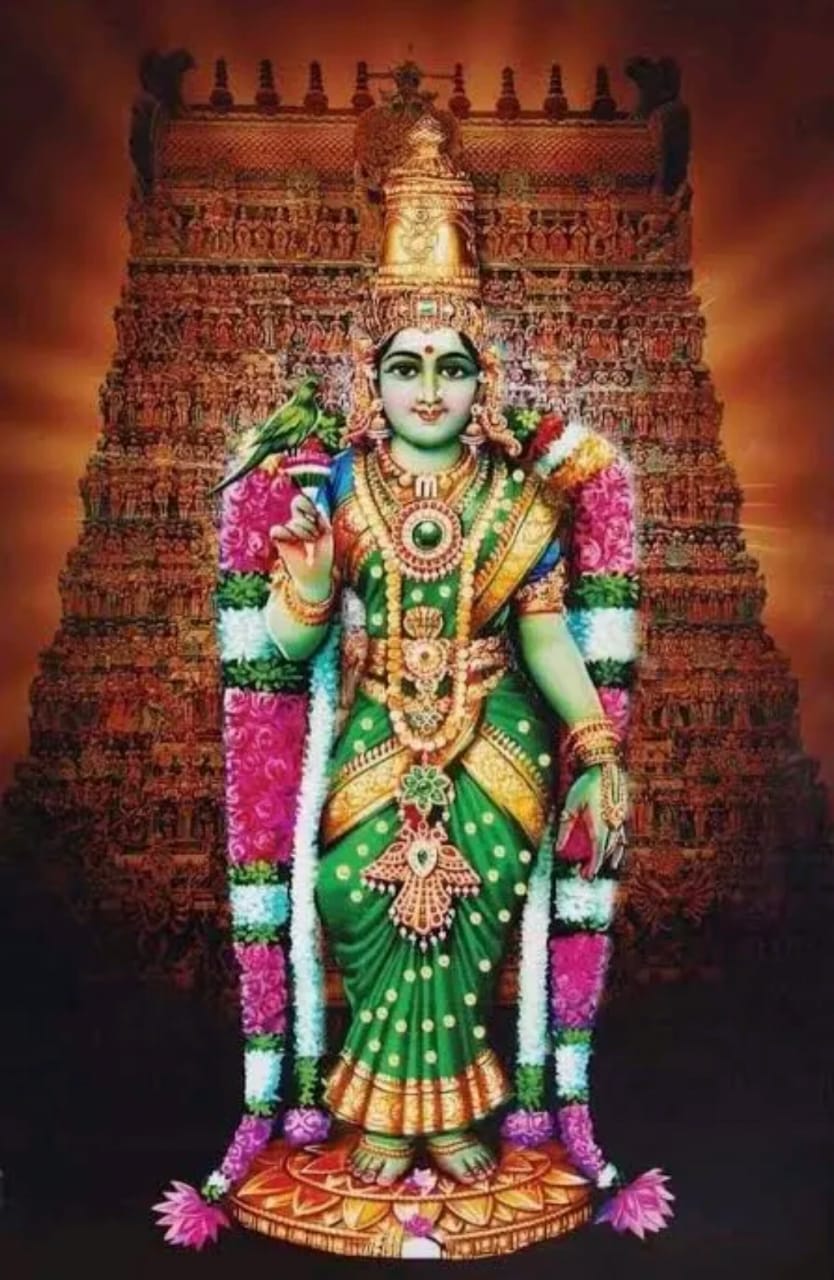
The Divine Mother as  Madurai Meenakshi

with Her captivating eyes is ready to bless Her devotees. 

C  N Nachiappun          

Singapore, 28 November 2020.

References:

1.       The Thousand Names of the Divine Mother published in English by Mata Amritanandamayi Center, San Ramon, California, USA, with Commentary by T. V Narayana Menon

2.       Shri Lalitha Sahasranama Stostram published in Tamil by N. Ramaswami Iyer charities’ societies, Trichirapalli, India, with Commentary by C. V. Radhakrishna Sastry.

3.     The Lalitha Sahasranamam published in Tamil by Shri Ramakrishna Thapovanam, Thiruipparaithurai, Trichy District, Tamilnadu, India with commentary by Shrimath Swami Sithbavandar 
Shri Lalitha Sahasranamam: Namam 307: Shri Ramya (OM ramyAyai namaH)

In Namams 275 to365, the Divine Mother’s  many forms providing benefits to Her devotees in great details are discussed.

The Divine Mother is lovely, attractive and gives delight to her devotees. 

Ramya is meant to be attractive; Ram means attractive or captivating, like the Shri Rama who is attractive to anyone who sees him, even though he may be bluish or slightly dark in colour. Ram is such a wonderful word even the Lord Shiva had confessed to his spouse Parvathi Devi that Ram is the best Namam he likes. 

Whatever object or thing we like will give us happiness. All natural happenings in this universe are delightful. Even through tragic events, the cruel beings are corrected to right path with the Divine Mother’s grace; these short term hardships will turn out to be delightful in the long run. The Divine Mother’s grace always creates the delightfulness. The thinking in itself that She is the delighting object, life and action is a form of worshipping Her. 

Her lovely beauty gives the delight to the devotee. Other girls’ beauty on seeing them may cause negative feelings. However, the Divine Mother’s beauty will be splendid thing to the observers which will attract them to worship Her. 

The Divine Mother’s presence gives great joy and energy to Her devotees’ hearts. From head to toe She is adorned with Her wonderful ornaments; Her beauty is not comparable to any others in this universe.

The Divine Mother with Her delightful beauty


C  N Nachiappun          

Singapore, 27 November 2020.

References:

1.       The Thousand Names of the Divine Mother published in English by Mata Amritanandamayi Center, San Ramon, California, USA, with Commentary by T. V Narayana Menon

2.       Shri Lalitha Sahasranama Stostram published in Tamil by N. Ramaswami Iyer charities’ societies, Trichirapalli, India, with Commentary by C. V. Radhakrishna Sastry.

3.       The Lalitha Sahasranamam published in Tamil by Shri Ramakrishna Thapovanam, Thiruipparaithurai, Trichy District, Tamilnadu, India with commentary by Shrimath Swami Sithbavandar

Shri Lalitha Sahasranamam: Namam 306: Shri Rajni (OM rAj ~ nai namaH)

In Namams 275 to365, the Divine Mother’s  many forms providing benefits to Her devotees in great details are discussed.

The Divine Mother is the Queen of Lord Shiva; Shiva is the Lord of all kings. 

The Divine Mother is the MahaRani or Empress of Lord Shiva and the Universe which She creates; She is the one who can control and rule over people and things in the universe; She is called the Rani or Queen. When we analyse the natures’ ways, it is functioning systematically. It implies that it is under a good ruler; here the ruler is the Divine Mother. She rules all over the vast universe; She is the Parasakti. 

Sovereignty of the worlds or the universe rests on the Divine Mother. This Namam reflects greatly on the Divine Mother’s uniqueness, commanding power, sovereignty and universal venerability and respectability. 


The Divine Mother, the Empress of the universe

and the Queen of Lord Shiva

C  N Nachiappun          

Singapore, 26 November 2020.


References:

1.       The Thousand Names of the Divine Mother published in English by Mata Amritanandamayi Center, San Ramon, California, USA, with Commentary by T. V Narayana Menon

2.       Shri Lalitha Sahasranama Stostram published in Tamil by N. Ramaswami Iyer charities’ societies, Trichirapalli, India, with Commentary by C. V. Radhakrishna Sastry.

3.       The Lalitha Sahasranamam published in Tamil by Shri Ramakrishna Thapovanam, Thiruipparaithurai, Trichy District, Tamilnadu, India with commentary by Shrimath Swami Sithbavandar 

Saturday, November 14, 2020

Shri Lalitha Sahasranamam: Namam 305: Shri Raja rajarchita (OM rAjarAjArchitAyai namaH)

 In Namams 275 to365, the Divine Mother’s  many forms providing benefits to Her devotees in great details are discussed. 

The Divine Mother is worshipped by all King of Kings or highest level of Kings. 

Lord Shiva is considered as the Supreme King or Raja for the humans. There is no comparison to Him. Such a king due to his superior powers is ruling the wider universe. Shiva understands the Divine Mother’s powers and glory; He keeps Her in his left side as in Artahanarishwarar form. Those who understand the powers of the Divine Mother, maintain their own status without wasting their own powers. So even Lord Brahma, Vishnu Shiva are worshiing Her, according to Soundarya Lahari verse one by Sage Adi Shakara. 

Manu or Kubera who started the Kings’ way of ruling the world, is the one of the twelve key worshippers of the Divine Mother. He lives in Sricakra between fourteenth and fifteenth walls in north east direction and prays to the Divine Mother. Raja Parmesvaran (Shiva) and His assistant Rajachandran or Rajarajan (Moon) are all worshipping the Divine Mother. 

Kubera  (controller of wealth) is considered the King of Kings. The first human kind king is him; he has the power to discriminate Puranas say that Kubera being the controller of wealth in this universe, it is likely for him to drift away from God, when his wealth level increases. People accruing merit through good deeds only can near the Brahman in spite increases in their wealth holdings. The man has the ability and becomes a thinking being; with his thinking ability, man had been worshipping the Divine Mother.

The Divine Mother as Raja Rajeswari


C  N Nachiappun          

Singapore, 25 November 2020.

References:

1.       The Thousand Names of the Divine Mother published in English by Mata Amritanandamayi Center, San Ramon, California, USA, with Commentary by T. V Narayana Menon

2.       Shri Lalitha Sahasranama Stostram published in Tamil by N. Ramaswami Iyer charities’ societies, Trichirapalli, India, with Commentary by C. V. Radhakrishna Sastry.

3.       The Lalitha Sahasranamam published in Tamil by Shri Ramakrishna Thapovanam, Thiruipparaithurai, Trichy District, Tamilnadu, India with commentary by Shrimath Swami Sithbavandar

Shri Lalitha Sahasranamam: Namam 304: Shri Heyopadeya varjita (OM heyopAdeyavarjitAyai namaH)

In Namams 275 to365, the Divine Mother’s  many forms providing benefits to Her devotees in great details are discussed. 

The Divine Mother does not reject or accept anything in this universe. 

The Divine Mother is beyond all acceptances or rejections. The humans continuously grow their body by regularly eating food; if there are any damaged sections beyond repair in the body, the humans try to discard them. But the embodied soul remains as it is. This soul is the Divine Mother in Her true state. In true state nothing is to be rejected or accepted. The Divine Mother is eternally Her own true Self. 

Vedas stipulate on things to do and or not to do in the path to seek the Supreme Self, here the Divine Mother. Due to past Karma the humans are conditioned by such vedic stipulations. However, such stipulations which originate from the Divine Mother Herself; they will not control Her. So there is nothing that the Divine Mother needs to avoid or accept in Her infinite state. 

There is nothing to be prescribed or to be avoided for Her.  The injections and or prohibitions mentioned in the scriptures do not apply to those who have realized/experienced the Truth. All universal things are in the Universal Truth form; what can be avoided in Her Supreme Self form? What can be accepted or taken in? The Divine Mother is such a Truthful Universal Supreme Self. 

Due to liking or disliking, the humans either accept or reject things. The Divine Mother is not having such liking or disliking for any universal thing. She is purna or a wholesome, full or infinite Herself. She is spreading all over the universe which She creates; there is not anything which She needs to reject and or accept as well. So the Divine Mother does nothing to accept or reject anything in this universe. 

Heyam can mean to the things to be avoided; opadeym means which is needed to be sought and accepted and varjita means which is beyond.

The Divine Mother
 

C  N Nachiappun          

Singapore, 24 November 2020.

References:

1.       The Thousand Names of the Divine Mother published in English by Mata Amritanandamayi Center, San Ramon, California, USA, with Commentary by T. V Narayana Menon

2.       Shri Lalitha Sahasranama Stostram published in Tamil by N. Ramaswami Iyer charities’ societies, Trichirapalli, India, with Commentary by C. V. Radhakrishna Sastry.

3.       The Lalitha Sahasranamam published in Tamil by Shri Ramakrishna Thapovanam, Thiruipparaithurai, Trichy District, Tamilnadu, India with commentary by Shrimath Swami Sithbavandar 

Shri Lalitha Sahasranamam: Namam 303: Shri Hrrdya (OM hRRidyAyai namaH)

In Namams 275 to365, the Divine Mother’s  many forms providing benefits to Her devotees in great details are discussed. 

The Divine Mother lives in the hearts of Her devotees; or Her best abode is the heart of Her Bakta with pure devotion. 

The devotes feel Her presence in their heart. For example, when a mirror is well cleaned, Sun’s brightness clearly reflects from that mirror. With pure heart, Her presence is felt more. When the heart is pure, the devotees visualize Her well within themselves in their hearts. 

When someone sees and likes an object, he has a desire to acquire it, as his mind has accepted the object having some value to him. The Divine Mother is acceptable to our minds with Her beauty and good attributes. She particularly likes the devotees who can control their senses and are quite in their outside dealings, without glorifying their own good deeds. 

Basically, the Divine Mother settles comfortably in the hearts of Her devotees. She does not prefer any special residence. Her best preferred residence is the heart of Her devotees. She chooses to live in the hearts of friends and foes or enemies without any enmity towards them. The enemy’s devotion in such case is called Virodhabhakti (devotion through enmity). Lord Krishna in Gita has emphasized that His devotees hearts His best residence which He likes very much. 

The Divine Mother is delightful; She gives out delight to everyone by living in the hearts of Her devotees.


The Divine Mother lives in hearts

of Her pure devotion devotees

C  N Nachiappun          

Singapore, 23 November 2020.


References:

1.       The Thousand Names of the Divine Mother published in English by Mata Amritanandamayi Center, San Ramon, California, USA, with Commentary by T. V Narayana Menon

2.       Shri Lalitha Sahasranama Stostram published in Tamil by N. Ramaswami Iyer charities’ societies, Trichirapalli, India, with Commentary by C. V. Radhakrishna Sastry.

3.       The Lalitha Sahasranamam published in Tamil by Shri Ramakrishna Thapovanam, Thiruipparaithurai, Trichy District, Tamilnadu, India with commentary by Shrimath Swami Sithbavandar 

Athangudi Karthigai function lighting

This Kerala type lamp has 24+24+1, total 49 lighting points. Susheela was given by her parents during our marriage. When she rearranged her ...